• Skip to primary navigation
  • Skip to main content
Turning Heads Kennel

Turning Heads Kennel

Alaska Dog Sledding Tours

  • Home
  • Tours
    • Summer Tours
      • Summer Dog Sled Ride
      • Summer Dog Sledding & Gold Panning Combo
      • Helicopter Glacier Dog Sledding
      • Flight Seeing 🚁
    • Winter Tours
      • Winter Dog Sledding Tours
  • About Us
    • Our Mushing Philosophy
    • 2025 Crew
    • The Dogs
      • Meet the Dogs
      • Learn About Dog Sledding
      • Adopt A Retired Sled Dog
    • Our Life
      • Travis Beals
      • Sarah Stokey
      • Our Story
      • Racing Schedule
      • Travis Beals Racing History
  • Contact
  • Shop
  • Support
  • News
  • Show Search
Hide Search

Dog Sledding Basics

Training Sled Dogs in the Fall and Why It’s Important For Success

Sarah · October 7, 2014 ·

Although it is called “dog sledding,” much of the important training that happens to a competitive dog sled team actually happens in the fall on ATVS or carts long before there is any snow. While perhaps strange to those unfamiliar with the sport, fall training provides a crucial first look at the team a musher has to work with for the coming season and puts on the early fitness foundation required for later success.

Most mushers generally start fall training some time during the month of September. Our kennel generally starts towards the end of the month as many of our dogs run all summer long doing dog sled tours and a few weeks off between the last tour and the official start of the season are needed for both dog and musher alike. After a few weeks, however, it is back to training. A team, especially one training for Iditarod, needs to build a solid conditioning foundation and this often takes several months to accomplish.

Iditarod is a 1,000 mile long dogsled race but at its core, is really nothing more than a canine marathon. The race is an endurance event that requires high levels of physical fitness and mental preparation from both the dogs and the mushers that run it. Just as humans need months to prepare for a marathon, our dogs require several months of training before they set out on Iditarod.

Training Sled Dogs: The First Few Runs

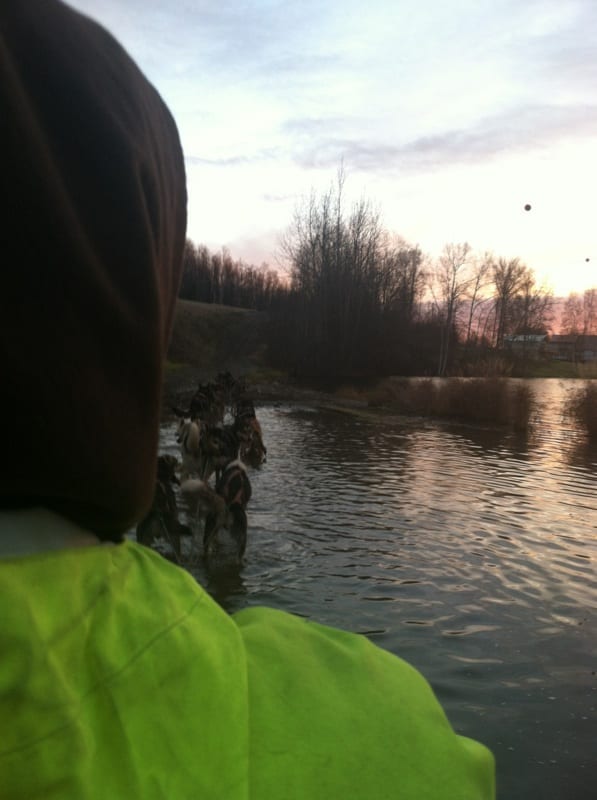
Fall training starts out in incremental steps where we slowly build mileage up for our dogs. First runs generally are between 5-7 miles in length and are highly dictated by the weather: huskies cannot run in warm weather so most runs are done in the early morning or at night, when temperatures are coolest. Often, these runs require numerous stops that allow the dogs time to pant so that the dogs can get rid of excess heat. Mushers also cater their training runs to hit water sources such as rivers, streams, or even large puddles where the dogs can drink and cool off.
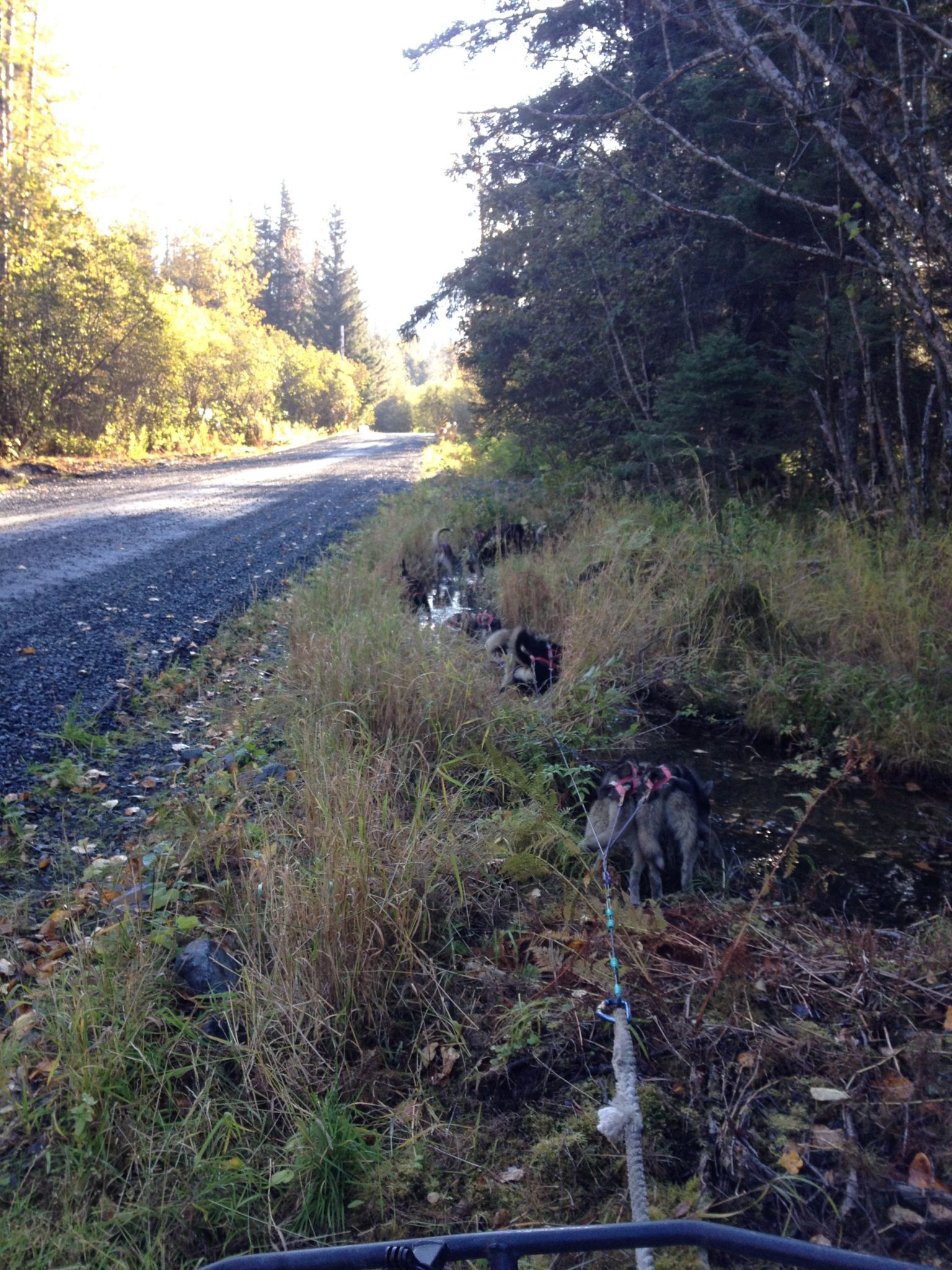
Training Sled dogs during the fall requires finding water sources. Here the team stops at a creek next to the road we train on.

Training Sled Dogs On ATVS

All-Terrain-Vehicles (ATVs) are equipped with numerous features that allow mushers to maintain maximum control of their team during fall training. The ATV is a good choice because we have both gas and brakes at our disposal as training tools. The ATV can also be put into various gears to determine how much the dogs will pull. When put into 1st gear, the dogs have to pull against the gears of the machine making for a tougher pull. Higher gears ease the pull and allow the dogs to travel faster by having to pull less. Generally, mushers vary gears throughout training.

We primarily run in 2nd and 3rd gear as well as neutral but will occasionally put the ATV in 1st gear and require the dogs to do some tough pulling. Other mushers, of course, do it differently.

Training early on in the season allows mushers to look at their dogs with fresh eyes from the previous season. With another year on their belt, dogs that previously ran in the team may now show qualities that warrant their training as a lead dog. In the fall, we run enough short runs that it is a great chance to try new dogs up front.

Positioning Sled Dogs in the Team

The fall is also a good time to bring younger dogs up onto the main team. During the fall, we spend run after run looking at how we match our dogs and where we place them in the team to maximize our efficiency.

For example, earlier this week I ran a dog named Cricket towards that back of the team. No matter what speed we traveled at, Cricket always trotted. As a young, energetic but smaller dog, if she is going to make our race team it will probably be as a lead dog. Knowing this later in the week I ran Cricket behind our swing dogs. I wanted to give her more experience up near the front of the team where, some day, she will hopefully end up. Up that far, Cricket trotted but whenever we started moving at a faster pace she loped. Our travelling speeds were no different than the run I had taken her out on earlier in the week. The team was also identical. The only thing that changed was Cricket’s position and that, it seemed, affected her gait. In general, we want our dogs to maintain a nice steady trot. Does this mean I will run Cricket in the back of the team? No, it means I need to work with her so that she can have her smooth trot further up in the team.

Chemistry: Finding The Right Match for Sled Dogs

In dog sledding, finding the right match for your dogs is also important. A good pairing of dogs can bring the best out in each dog while a bad pairing can bring out the worst. Often, we find that dogs can be paired with one or two other dogs. We aren’t talking about getting along: all of our dogs get along well. When we talk about pairing, we talk about having two dogs that work and move in sync and that also motivate each other to work hard.

Ideally, we want a team that moves as a single unit, rather than as 16 disjointed pieces. A well-trained dog team should move in sync, the legs of the dogs moving synchronously so that as one dog swings his front legs forward, they all do. Having good pairs is important because it is the pairings that comprise the team. Mushers often talk, admire, and want beautifully gaited dogs because the dog is the first building block of smooth team.

Moving Sled Dogs Around

In training sled dogs, especially in the summer during tours and in the fall when we are more focused on short runs, we can try many new pairings. Many mushers like to move dogs around during runs but we generally do not do that in our kennel. We want our dogs to know that if they are hooked up in a certain position or next to a certain dog they will finish the run in that position next to their partner.

There are some exceptions to this, of course, but most of those involve working with young dogs. With young dogs, our goal is to focus on making their time out on the trail positive and to inspire confidence. This is no different than we do with young kids: we don’t start off pitching curve balls to first graders, they hit a ball off of stand. We make things as easy as possible for our young dogs and build their confidence thus setting them up for success later on in their careers.

How Do We Pick Sled Dog Pairings?

So if pairings are so important, how do we pick them? Really talented mushers usually just know after a few runs. These are the dog-savy people who just innately have a gift of understanding and communicating with dogs. For the rest of us, it’s trial and error. Often, there are many clues that dogs will run well together. Typically littermates or dogs from similar genetic backgrounds will run well together as, genetically speaking, they should have similar builds. Similarly sized dogs also generally do well together. Other than that, it requires assessing a dog’s gait. Believe it or no, most top mushers do not have perfectly gaited dogs — what they have is well-paired dogs.

Training Sled Dogs: Finding A Lead Dog

The fall also lends itself as a great time to train new lead dogs as the control of the ATV makes it easy if problems arise or commands are perfectly followed. We say “finding” new leads dogs as, with any leader, the dog must have certain traits that cannot be trained into it. Lead dogs are generally some of the most eager to run dogs on a team as well as the most athletic. While most people believe that intelligence is important, it is actually the least important trait that our leaders have.

In our kennel, we look for three traits: athleticism, attitude, and aptitude. In some dogs, these traits stand out in a dog even as a young pup – at that time it’s clear this dog is a leader and should begin some form of leader training. Other dogs, however, mature into having the all-star can-do-it attitude that mushers look for and rely on in their lead dogs.

In any event, when we find lead dogs training them in their initial runs in lead on an ATV can be very beneficial as the ATV maximizes our ability to reward our dogs. Our dogs naturally want to run and pull – they wouldn’t be sled dogs if they didn’t – so training a lead dog is all about channeling that pull in the right direction. The commands we use in mushing are “gee” for right and “haw” for left.

Using the ATV, we can reward the dogs when they get a command correct by giving the ATV a little gas. If the dogs do not get the command right, we simply stop the team. Because these dogs want to run and because they hear us talking to them, they will try to do something different – like try a different direction – to see if that produces their desired result which is, of course, to resume running. That is it. That is the great secret to training commands to our lead dogs. While it takes lots of patience, we aren’t doing anything extraordinary. We are simply using our dogs love of running as positive reinforcement.

Why Is Training Sled Dogs In Th Fall So Important?

Fall training is important because it is a time of trying new things and getting back in the groove of training. Properly conditioning the dogs for long distance events such as Iditarod is important and requires that mushers start months in advance so that when it is time to race, the dogs are at their peak physical condition and have a solid foundation. It is also the start of that season’s adventures and we are always excited with possibility about what our team will be able to accomplish in the months to come.

You can learn more about fall training from an earlier post we did: Fall Training For Sled Dogs.

Seppala Kennel‘s also has an excellent post about the progression of training from fall to winter.
What Is A Sled Dog

Sarah · September 30, 2014 ·

Sled Dogs: An Overview

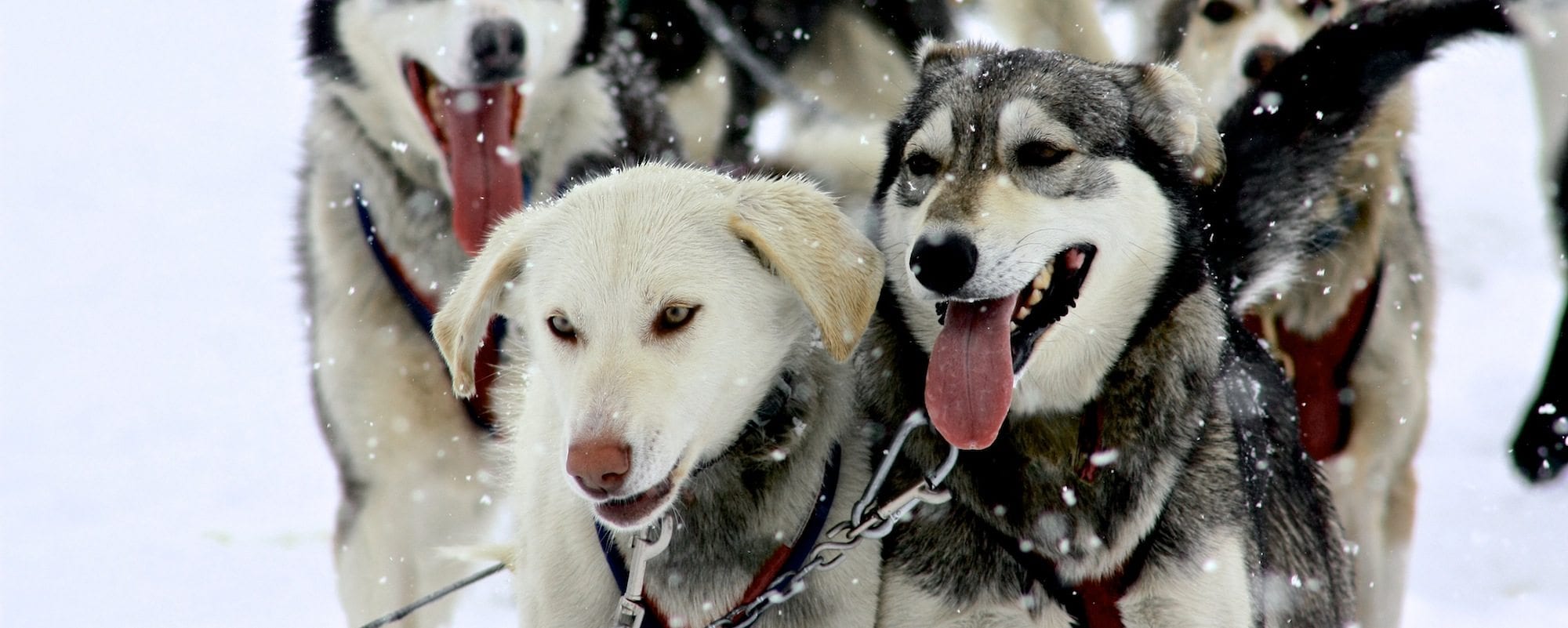
An Alaska Mushing Tour featuruing Pinky and Mary

Sled dogs are dogs that have been trained to pull sleds across snow. In months where there is no snow the dogs train on dirt and sleds are substituted for carts, ATVs, or even vehicles. Travis and I primarily use ATVs for training purposes and use carts for our summer tours. While we have never run dogs on our truck, we know many mushers who have; it is a very efficient way to train lots of dogs at once.

While any dog is technically capable of becoming a sled dog, those specifically bred for the purpose of running and pulling show the most athletic talent on the trail. There are three main breeds of dog used today: The Siberian husky, the Alaskan malamute, and the Alaskan husky.

The Siberian husky is the most well-known sled dog breed as it is typically used in movies, advertisements, and on postcards. The malamute is primarily associated with freight hauling and weight-pull competitions, but played a crucial role in Alaska’s early development as a freight-hauling dog. Here at our kennel, we focus on racing and training Alaskan huskies who are a highly versatile breed of sled dog and are the dog of choice in dog sled races due to their speed, stamina, and drive.

Common Sled Dog Breeds

Siberian Huskies – The Traditional Sled Dog

When you think of sled dog, it’s hard not to picture a beautiful Siberian Husky. While less popular in today’s racing circuit than the Alaskan Husky, the Siberian husky has many years of history in Alaska. Teams of Siberian huskies were used to haul freight and mail over supply trails in Alaska during the winter.

The most famous of these dogs was a Siberian husky named Balto from Nome, Alaska. Balto was a black Siberian husky owned by Gunnar Kaasen, Balto is known for his roll in helping to save the village of Nome from a deadly diphtheria outbreak. In 1925, Nome was only accessible by dog team in the winter. When children in Nome suddenly started contracting diphtheria, life-saving serum was transported hundreds of miles by dog sled relay. Balto, was the lead dog on the final team that delivered the medicine in to Nome. His story is commemorated through film, book, and statue: there is a statue of Balto in Central Park in New York City. For more information on Balto and the 1925 Serum Run check out Balto’s True Story.

As a breed, Siberian huskies are known for their inquisitive minds as well as their independent nature. As pet dogs, they can prove to be a nuisance as they love to roam and explore.

We own one Siberian husky named Faraday. She knows exactly what she likes and what she doesn’t like and can often be found slinking around outside acting as if she is about to get into trouble of some sort. She rarely chooses to come inside our home, instead preferring the comfort of a doghouse. She is happiest, it seems, when left to her own devices. We treasure the moments when she chooses to grace us with her presence and her affection as they are somewhat few and far between.

Faraday rests on her house during a sled dog tour.

Although not as popular in dog sled races, there are still many mushers who choose race Siberian huskies. Lisbet Norris of Anandyr Siberians is a good friend. Lisbet and her family now have the longest running Siberian Husky Kennel in the world. She will be competing in Iditarod 2015. In the 2014 Iditarod, Travis spent many hours on the trail with Mike Ellis and his team of Siberian Huskies. Karen Ramstead, of Canada, is another musher who races Siberian Huskies. Lev Shvarts runs both Siberian huskies and Alaskan Huskies and will be competing in the 2015 Iditarod — Lev is one of the first people to teach me how to run sled dogs. I started my journey training sled dogs back with Lev in Winchenden, MA back in 2010 and am excited to be sharing the race trail with him this year.

Alaskan Malamutes – Freighting Sled Dogs

These are the big, fluffy dogs used primarily during the Gold Rush for freight hauling as well as for trap lining. In general, the malamutes tend to be slow when compared to teams of Siberian Huskies and Alaskan Huskies. Teams of malamutes were renowned for their incredible strength. Today, malamutes primarily compete in weight pull competitions but were historically important in Alaska as freight-hauling dogs.

The Alaskan Husky – The Racing Sled Dog

Contrary to popular belief, the Alaskan husky is not a purebred dog. Many Alaskan huskies have genetic traits linking them to Siberian huskies, Alaskan malamutes, German-shorthaired pointers, Irish setters, and other hunting dogs. These breeds were bred in for various reasons but, in the end, the goal was to create a better sled dog.

When giving a sled dog tour, we often explain to our guests that the Alaskan husky is an expensive northern breed mutt – but it’s important to note that we have extensive family trees on our dogs. Knowing these family trees helps us to make good breeding decisions and gives us a better idea of the litter we will produce.

Sarah Stokey in the 2011 Tustumena 200 Dog Sled Race
Sarah Stokey in the 2012 Tustumena 200 with a team of Alaskan Huskies. Photo courtesy of Clark Fair.

One thing that is often very misleading to people unfamiliar with the Alaskan Husky is that the Alaskan husky can come in a wide variety of colors, sizes, and hair lengths. Because of this, it may be easier to think of the Alaskan Husky as a “type” of dog, with many different “sub-types.” For example, a musher who is breeding dogs for a 30 mile sprint event is going to be looking for different traits than a musher who is breeding dogs for a 1,000 mile event. Yet, if you ask these mushers what kind of dogs they have, they would both answer “Alaskan Husky” despite the fact that because the dogs are being bred for different purposes they are, ultimately, going to differ physically. In general, dogs participating in long distance racing such as the 1,000 mile long Iditarod or Yukon Quest, tend to larger framed bodies than those who participate in sprint events which generally are no longer than 30 miles.

Because the Alaskan husky is more of a loose categorization than an actual breed, we also routinely see widely varying personality traits. We have exuberant dogs who are quick to show affection as well as shier dogs who prefer keeping to themselves and focus strictly on their jobs. This is because the Alaskan Husky is a melting pot of talented working athletes. Their high energy, their love of running, and their physical build help define these incredible dogs. For more information on Alaskan Huskies, check out Aliy Zirkle and Allen Moore’s “Dog Mushing Basics” as well as the Iditarod Trail Committee’s “What Is A Sled Dog.”

A Very Brief History of Sled Dogs In Alaska

Historically, sled dogs were the primary method of transportation during the winter months in Alaska. Natives used sled dogs as a way to help with their nomadic lifestyle as they followed herds of caribou. The dogs helped natives move their camps efficiently in the cold winter climates.

During the gold rush in Alaska, sled dogs provided a vital lifeline for the miners in the interior with the outside world. Ships would unload cargo in Seward, Alaska (where our kennel is located) and sled dogs would then deliver that cargo as far as 1200 miles away in the town of Nome, Alaska.

Positions a Sled Dog Can Have In A Team

In dogs sledding, where the dogs are located in the team affects what they have to do. The most involved position belongs to the lead dog, who has to listen and take commands. Other positions on the team include the swing dogs, the team dogs, and the wheel dogs. Most dogs can run on either the left or right side of the gangline and in multiple positions.

Lead Dogs

The most important position in the team belongs to the lead dog. The lead dog or dogs are at the front of the team. While it is more common, especially in media portrayals of dogsledding to see two lead dogs, many lead dogs actually do a better job working alone. The lead dog is responsible for listening to the musher, responding properly to commands, and making sure the team stays on the trail.

When determining new candidates for lead, we look at the 3 A’s: Attitude, Aptitude, and Athleticism. Dogs who run up front need to have at least two of these traits but ideally all three to be a candidate for a lead dog in our kennel.

Swing Dogs

Swing dogs are the pair of sled dogs who run directly behind the lead dogs. The swing dogs are generally leaders as well. Later on in the training season, we may put a pair of young dogs in this position if we see that they have the potential to lead.

This position is a great place to start potential leaders as they are up front in the team but do not have all the pressure of being a lead dog. Dogs in swing still have ability to learn the association between a musher’s commands and the movement of the team. Because of this, it’s thought that running dogs in swings help prepare them for lead dog training later on.

Wheel Dogs

Wheel dogs run directly in front of the sled. Generally, mushers run larger dogs here. Wheel dogs received their name because they are responsible for helping turn the sled. Some mushers prefer running a single wheel dog as when dog sledding the back of the team and the sled can get pulled into corners. By running only one wheel dog, the dog has more mobility when going through twisting trail.

Team Dogs

Team dogs are the dogs in the every other position in the team. There is no special delineation for each set of team dogs. Although they are generally thought of as interchangeable, a good musher knows exactly where to place team dogs to maximize efficiency and work in their team.

Do you have any other questions about sled dogs? Let us know in the comments below!

The Other Half of Iditarod

Sarah · November 20, 2013 ·

Without saying, there is obviously a lot that goes into Iditarod. But, what exactly does it entail? For this kennel, what Iditarod has meant this year is lots of time apart. The realities of training a competitive distance dog team mean that you need to log lots and lots of training miles.

How many miles?

Well, different mushers have different strategies and that “special number” is something that many mushers actually like to keep “under-wraps.” Why? I have no idea…perhaps they think it is their “special” formula for success… But The reality is that most competitive teams have somewhere between 3,000-5,000 miles on their dogs before the start of the race. Of course, like everything, there are exceptions: older dogs who have travelled to Nome several times before often don’t require as much training as dogs who have only done the race once or twice. Still, miles are important

And miles, ultimately, means time apart — especially when our home base is Seward. There is a reason we are the only year-round kennel in this town: it’s because there are no trails. In the winter, when we have snow (which we don’t at the moment), we are able to put about 20 miles on the dogs by running out to Kenai Fjords National Park and back…in order to train the dogs, we often have to do at least a 60 mile run meaning we do the whole course 3 times. Because we run out to the Park and then back, we actually will cover the same trail approximately 6 times on one run. An

Travis training at sunset

This however gets very repetitive and the dogs often grow “sour.” Just imagine how you would feel if you had to run a marathon on a highschool track. It might be ok the first time. The next time you might get a little bored. By the 6th or 7th time, no matter how much you love to run, you are inevitably going to ask: why am I doing this?

We want to keep our dogs attitudes up and our own attitudes. So this year, Travis has been training all over the state. Most of the time, he is Knik, Alaska mushing with friend Wade Marrs. Together, they also travelled north to the Denali Highway where they did a series of camping trips.

But where exactly does this leave me?

Stuck at home.

With only myself and Travis currently working with the dogs, it means that I get to take care of the next generation of our kennel. We had several litters of puppies this year because our goal is ultimately to field two competitive Iditarod teams. So far, even though being at home means I cannot train, I have had a blast working with our puppies who are going to be the heart and soul of our kennel in the coming years.  Still, I will admit it is definitely tough staying at home. There a lot of work involved in the day to day running of a kennel; but more importantly, I just miss Travis. But, it’s all for the greater good… we are training to have a stellar season and being successful ultimately means we have to make certain sacrifices.

Wish us luck as we train. Have questions about Iditarod? Please, make sure to email us and we will post about them! If you enjoyed our post, please make sure you share it with your friends.

Sled Dogs & Fall Training

Sarah · November 1, 2012 ·

We’ve received a lot of questions recently regarding fall training: what is it, how do we do it, and why. Well, Fall Training is an integral part of what we do  here at Turning Heads Kennel. During fall training, the dogs transition from doing light running during our summer tours to building up muscles and conditioning themselves in preparation for the longer runs required for racing 200 & 300 mile events as well as the Iditarod. So without further adieu, here is our Fall Training 101 Q&A.

sled dogs training in the fallHow do you train dogs in the fall?

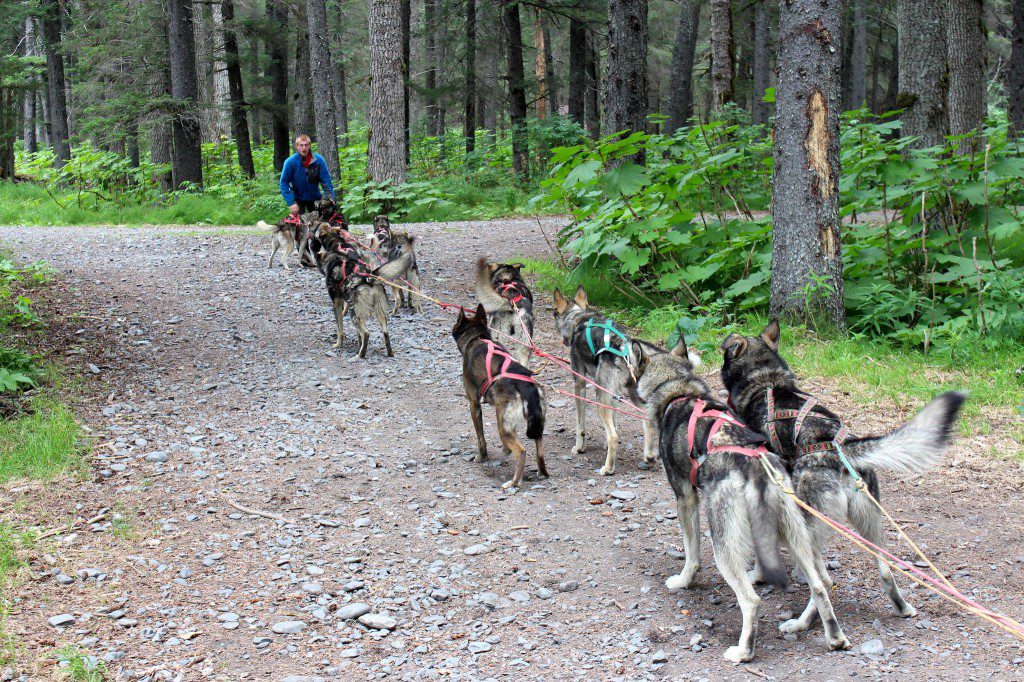
In the fall, we train dogs on an ATV. Generally, we hook up between 10-16 sled dogs. We enjoy training on the ATV: we have loads of control and besides being just a vehicle to train the dogs with, the ATV can actually act as a training mechanism. We can put the ATV into gear. When we put the ATV into first gear, the dogs have to work against the engine of the machine making for a tougher pull. It also slows the dogs down. Generally, we don’t run the dogs in first gear a whole lot. It’s bad for the machines and we believe that they don’t need to be working quite that hard. More often than not we’re in 3rd or 4th gear or in neutral, but it’s a fine balance. We like our dogs to run at a steady trot. Generallly, in 3rd or 4th gear to keep the dogs from going to fast light braking may need to be applied.

The benefit of running the ATV in gear is you can use the gas of the machine as positive reinforcement if you are working with new leaders. For example, you come to a 3 way intersection and you say “Gee” (the command to go right) if the dog begins to go right, you can give the machine a little gas and the dog a “good dog!” reaffirming that the dog made a good decision. If the dog however went to the left, you apply the brake of the machine. As soon as the lead dog begins to look toward the right/gives an inclination that he thinks going to the right is a good idea, you give a little gas. In that way, all we are doing is taking the dogs own desire to run and go forward, and channeling it. Running becomes the positive reinforcement, stopping the negative.

What are the benefits of fall training?

The greatest benefit of fall training is the control using an ATV gives you for training sled dogs. You can set the pace of the team. We like to use fall training as the time to teach our dogs to travel. We want them to learn that trotting is the most efficient way for them to move down the trail and that we want them trotting from the beginning of a run.

What are your trails like during the fall?

Unfortunately, here in Seward we are severely limited by the number of trails we have. The recent flood destroyed most of our trails and we are currently running a small section of dirt road by our house and the trails we use for our summer dog sled ride.

You run sled dogs on dirt roads?

Yes. Dirt roads are great to run on. We’d obviously prefer trails. Dirt or silt is ideal — it doesn’t hurt the dogs feet and they can run for quite awhile on it without wearing their pads down, but we are limited by what is available to us.

Do you have to watch out for cars or people?

Unfortunately there are many hazards associated with running our dogs on dirt roads, traffic being one of them. Fortunately, we don’t have to worry about our dogs. They have learned that they are supposed to run on the right side of the road, even when taking corners — something hard for them to do as they generally like to cut the corners. We don’t worry about our dogs passing vehicles or that sort of thing,they are very accustomed to it. What we do worry about is inattentive drivers or impaired drivers, but that’s something everyone worries about. We run a lot at night, when it’s cooler. It also makes it easier to see cars coming.

We actually pass lots of bikers, walkers, and other dogs. They are never an issue. The biggest problem we have is rabbits. We have a few lead dogs who enjoy chasing them and for whatever reason our neighborhood is plagued by an overabundance of them.

How far do you run your sled dogs in the fall?

You have to strike a fine balance in the fall between running enough and not running too much. The main concern about running this time of year is the dogs’ feet. Running on the dirt roads tears them up. We want to be conditioning the dogs but we don’t want to hurt their feet either. Generally, we find a balance that works. Once the snow comes, we don’t worry. Even 2  inches would protect the dogs feet sufficiently; we would still train on the ATV as that’s not enough to safely stop a dog team on a sled. That’s sort of where we are at right now, waiting for the snow so we can run a little further.

Is there any way to protect the sled dogs’ feet?

Yes. We use dog booties. Sort of like little socks for their feet. Unfortunately, they wear through very quickly in the fall time and it isn’t the most cost-effective means for training. Generally, we put a fleece bootie on to cushion the dogs pad and then put another “normal” bootie over top.


If you have any more questions about fall training please email us at Info@TurningHeadsKennel.com Next week we will do a Q&A with Travis about his Iditarod Training. Please email any questions you’d like answered then!

Sled Dogs Have Olympic Sized Diets

Sarah · August 15, 2012 ·

This Article Appeared in the August 15th Edition of the Seward Journal

Fall is slowly starting to creep in, and the dogs can tell. Cooler temperatures have begun settling over Seward and there is a tangible excitement hanging over our dog lot. The dogs know, like we do, that fall training is almost here – weeks? days? – and they are more than ready. On the rainy days when we have hooked them up for tours, the dogs are particularly loud, anticipating the longer runs that will soon come.

We’ve begun thinking about what this winter will mean for us too. Keeping dogs is no easy task, let alone Iditarod dogs. They are the Olympians of the dog world and have Michael Phelps sized diets. During Iditarod our dogs will burn 10,000 to 12, 000 calories a day, so we have to put even more back in to them. The summer months generally bring a reprieve from high food costs as the warm summer temperatures combined with the shorter runs mean the dogs burn fewer calories. Currently we are feeding one ton of dog food a month and as training begins that will only go up. Needless to say we have begun to think about fundraising to help alleviate our dog food costs.

We’ve also been slowly building new houses for our dogs too. Good houses mean the dogs stay warmer and are better protected from the elements. We still have another ten out or so houses to build before summer ends, but we are happy with our progress. The dog yard certainly is brighter as we’ve painted our houses brilliant shades of green, yellow, blue, pink, and red. The colors make the yard a fun place to be even on the rainiest of days Seward.

We’d like to remind the  Seward community that we will happily take any freezer burnt meat or fish and to remember us this hunting season. Our dogs love bones and meat scraps. We also invite anyone who is interested in helping us fundraise to send us an email atTurningHeadsKennel@gmail.com

  • « Go to Previous Page
  • Page 1
  • Interim pages omitted …
  • Page 5
  • Page 6
  • Page 7

Turning Heads Kennel

© 2026 · Turning Heads Kennel . Sitemap

  • Home
  • Tours
  • About Us
  • Contact
  • Shop
  • Support
  • News