• Skip to primary navigation
  • Skip to main content
Turning Heads Kennel

Turning Heads Kennel

Alaska Dog Sledding Tours

  • Home
  • Tours
    • Summer Tours
      • Summer Dog Sled Ride
      • Summer Dog Sledding & Gold Panning Combo
      • Helicopter Glacier Dog Sledding
      • Flight Seeing 🚁
    • Winter Tours
      • Winter Dog Sledding Tours
  • About Us
    • Our Mushing Philosophy
    • 2025 Crew
    • The Dogs
      • Meet the Dogs
      • Learn About Dog Sledding
      • Adopt A Retired Sled Dog
    • Our Life
      • Travis Beals
      • Sarah Stokey
      • Our Story
      • Racing Schedule
      • Travis Beals Racing History
  • Contact
  • Shop
  • Support
  • News
  • Show Search
Hide Search

Iditarod

Qualifying for the Iditarod

Sarah · January 8, 2015 ·

Qualifying for the Iditarod

The Iditarod is a 1,000 mile long dog sled race run annually in Alaska by some of the top mushers in the world. The race tests the bond and endurance of the musher and their team of sled dogs. It’s an impressive event with many nuances. Learn more about it in our earlier post What Is the Iditarod Sled Dog Race. In order to participate for the event, new entrants, called rookies, first have to qualify for the race. In qualifying, mushers are proving that they know how to take care of both their dogs and themselves in Alaska’s winters and wilderness.

One of the most basic requirements is the age limit. In order to participate in Iditarod, a musher must be at least 18 years old and have qualified for the race by completing a series of mid-distance races.

According to Rule #1 of the Official Iditarod Rules:

he/she must complete two (2) 300 mile qualifiers and another approved qualifier for a total of 750 miles to be qualified. The completion requirements are that a musher must finish either within the top 75% of the field or in an elapsed time of no more than twice the time of the winner.; and he/she during such approved qualifying races demonstrated the necessary physical and mental aptitude and preparedness, as well as the necessary wilderness and mushing skills.

The Iditarod keeps an updated list that can be found on their website of which races count as qualifiers. Along with completing the race, racers must have specific paperwork filled out. These “report cards” are often filled out by the head race marshall of that specific race. This helps ensure that all those who set out on the Iditarod trail are qualified to be there.

In addition to completing the races and having their report cards filled out, Iditarod rookies must also provide a reference letter from someone who is familiar with the race. This is another measure to help ensure those on the trail have the necessary skills to be out there.

Why Must Mushers Qualify for the Iditarod?

The goal of qualifying races is to ensure that all mushers know how to take care of themselves and their dogs.  One thousand miles is a long way to travel and the entirety of the race is off of the Alaska Road system. Mushers and their dogs must be prepared to face any challenge.

On the path to qualifying, Rookie mushers generally learn a lot both from experience and from other mushers. Once a musher has successfully completed the Iditarod, they no longer need to qualify. One successful completion of the race is considered qualification for life.

Travis used the Northern Lights 300, The Tustumena 200, and the Tiaga 300 to qualify for the 2013 Iditarod. Travis has now run the Iditarod 11 times, with a top finish of 5th place!

Sarah used the Sheep Mountain 300, The Northern Lights 300, and the Tustumena 200 to qualify for Iditarod. Sarah ran the Iditarod in 2016 and in 2019.

Rookie Iditarod Meeting

Before a musher’s Rookie Iditarod, they participate in a 2-day mandatory Rookie Meeting. Running a 1,000 mile long race is very different than running a 300 mile event. No matter how much wilderness or mushing experience you have, nothing can ever truly prepare you to race the Iditarod.

The Rookie meeting’s purpose is to help answer questions specific to the race and familiarize new mushers with the logistics. During the training, rookie mushers learn about vet care, training their dogs for Iditarod and how it differs from shorter races, and what to expect during the race. The Rookie Meeting is hosted by Iditarod and usually attended by several veteran mushers who offer value feedback to novices.

What Happens When you Finish the Iditarod?

When a musher completes his/her first Iditarod, he earns their Iditarod Belt Buckle, a one time piece of hardware that only official finishers of the Iditarod Sled Dog Race can sport. They also become members of the Iditarod Official Finishers Club. This club helps provide oversight to the race by providing valuable feedback to Iditarod’s board of directors.

Once a musher has successfully completed Iditarod, they no longer need to qualify.
 

Training Sled Dogs in the Fall and Why It’s Important For Success

Sarah · October 7, 2014 ·

Although it is called “dog sledding,” much of the important training that happens to a competitive dog sled team actually happens in the fall on ATVS or carts long before there is any snow. While perhaps strange to those unfamiliar with the sport, fall training provides a crucial first look at the team a musher has to work with for the coming season and puts on the early fitness foundation required for later success.

Most mushers generally start fall training some time during the month of September. Our kennel generally starts towards the end of the month as many of our dogs run all summer long doing dog sled tours and a few weeks off between the last tour and the official start of the season are needed for both dog and musher alike. After a few weeks, however, it is back to training. A team, especially one training for Iditarod, needs to build a solid conditioning foundation and this often takes several months to accomplish.

Iditarod is a 1,000 mile long dogsled race but at its core, is really nothing more than a canine marathon. The race is an endurance event that requires high levels of physical fitness and mental preparation from both the dogs and the mushers that run it. Just as humans need months to prepare for a marathon, our dogs require several months of training before they set out on Iditarod.

Training Sled Dogs: The First Few Runs

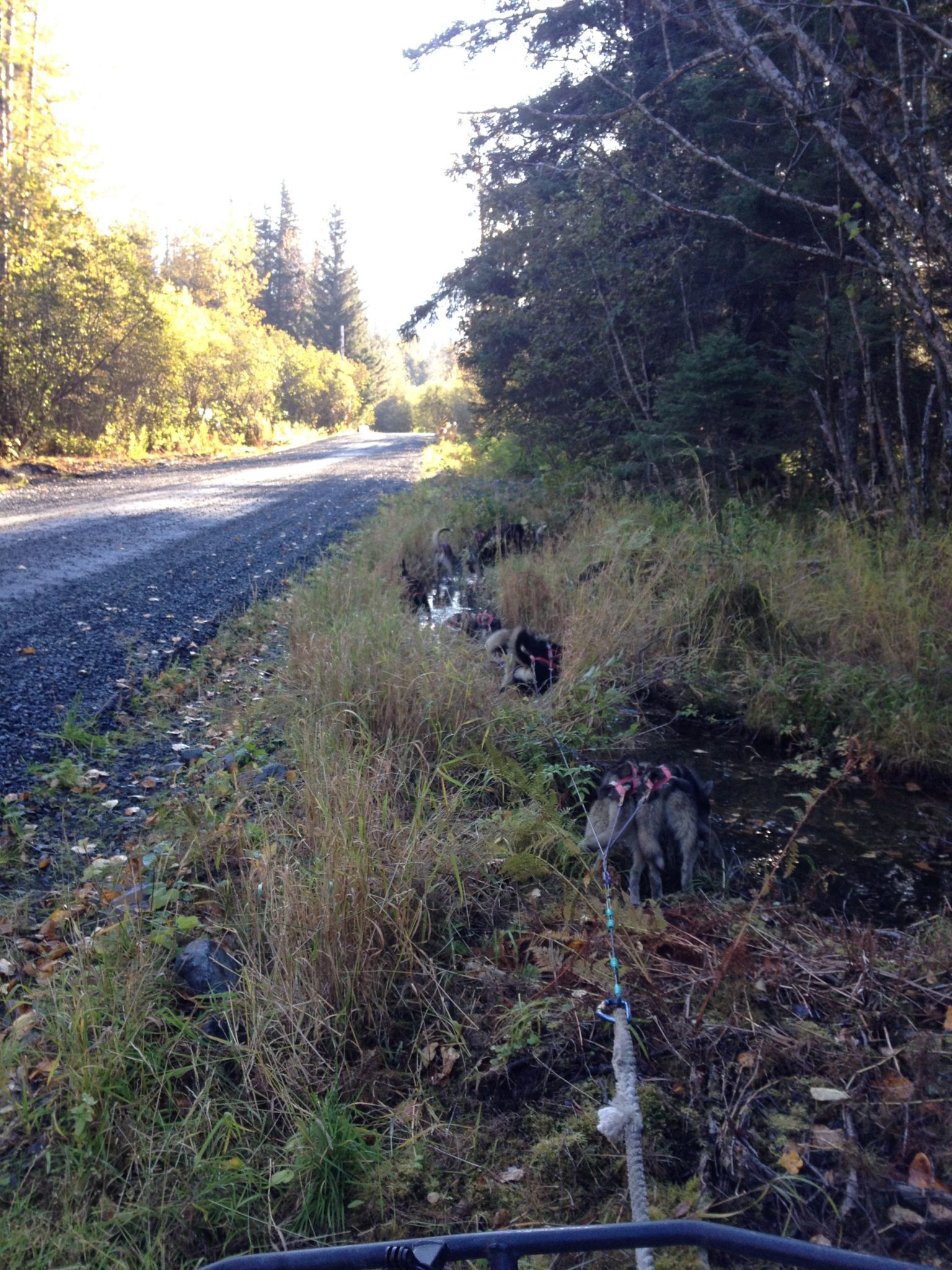
Fall training starts out in incremental steps where we slowly build mileage up for our dogs. First runs generally are between 5-7 miles in length and are highly dictated by the weather: huskies cannot run in warm weather so most runs are done in the early morning or at night, when temperatures are coolest. Often, these runs require numerous stops that allow the dogs time to pant so that the dogs can get rid of excess heat. Mushers also cater their training runs to hit water sources such as rivers, streams, or even large puddles where the dogs can drink and cool off.

Training Sled dogs during the fall requires finding water sources. Here the team stops at a creek next to the road we train on.

Training Sled Dogs On ATVS

All-Terrain-Vehicles (ATVs) are equipped with numerous features that allow mushers to maintain maximum control of their team during fall training. The ATV is a good choice because we have both gas and brakes at our disposal as training tools. The ATV can also be put into various gears to determine how much the dogs will pull. When put into 1st gear, the dogs have to pull against the gears of the machine making for a tougher pull. Higher gears ease the pull and allow the dogs to travel faster by having to pull less. Generally, mushers vary gears throughout training.

We primarily run in 2nd and 3rd gear as well as neutral but will occasionally put the ATV in 1st gear and require the dogs to do some tough pulling. Other mushers, of course, do it differently.

Training early on in the season allows mushers to look at their dogs with fresh eyes from the previous season. With another year on their belt, dogs that previously ran in the team may now show qualities that warrant their training as a lead dog. In the fall, we run enough short runs that it is a great chance to try new dogs up front.

Positioning Sled Dogs in the Team

The fall is also a good time to bring younger dogs up onto the main team. During the fall, we spend run after run looking at how we match our dogs and where we place them in the team to maximize our efficiency.

For example, earlier this week I ran a dog named Cricket towards that back of the team. No matter what speed we traveled at, Cricket always trotted. As a young, energetic but smaller dog, if she is going to make our race team it will probably be as a lead dog. Knowing this later in the week I ran Cricket behind our swing dogs. I wanted to give her more experience up near the front of the team where, some day, she will hopefully end up. Up that far, Cricket trotted but whenever we started moving at a faster pace she loped. Our travelling speeds were no different than the run I had taken her out on earlier in the week. The team was also identical. The only thing that changed was Cricket’s position and that, it seemed, affected her gait. In general, we want our dogs to maintain a nice steady trot. Does this mean I will run Cricket in the back of the team? No, it means I need to work with her so that she can have her smooth trot further up in the team.

Chemistry: Finding The Right Match for Sled Dogs

In dog sledding, finding the right match for your dogs is also important. A good pairing of dogs can bring the best out in each dog while a bad pairing can bring out the worst. Often, we find that dogs can be paired with one or two other dogs. We aren’t talking about getting along: all of our dogs get along well. When we talk about pairing, we talk about having two dogs that work and move in sync and that also motivate each other to work hard.

Ideally, we want a team that moves as a single unit, rather than as 16 disjointed pieces. A well-trained dog team should move in sync, the legs of the dogs moving synchronously so that as one dog swings his front legs forward, they all do. Having good pairs is important because it is the pairings that comprise the team. Mushers often talk, admire, and want beautifully gaited dogs because the dog is the first building block of smooth team.

Moving Sled Dogs Around

In training sled dogs, especially in the summer during tours and in the fall when we are more focused on short runs, we can try many new pairings. Many mushers like to move dogs around during runs but we generally do not do that in our kennel. We want our dogs to know that if they are hooked up in a certain position or next to a certain dog they will finish the run in that position next to their partner.

There are some exceptions to this, of course, but most of those involve working with young dogs. With young dogs, our goal is to focus on making their time out on the trail positive and to inspire confidence. This is no different than we do with young kids: we don’t start off pitching curve balls to first graders, they hit a ball off of stand. We make things as easy as possible for our young dogs and build their confidence thus setting them up for success later on in their careers.

How Do We Pick Sled Dog Pairings?

So if pairings are so important, how do we pick them? Really talented mushers usually just know after a few runs. These are the dog-savy people who just innately have a gift of understanding and communicating with dogs. For the rest of us, it’s trial and error. Often, there are many clues that dogs will run well together. Typically littermates or dogs from similar genetic backgrounds will run well together as, genetically speaking, they should have similar builds. Similarly sized dogs also generally do well together. Other than that, it requires assessing a dog’s gait. Believe it or no, most top mushers do not have perfectly gaited dogs — what they have is well-paired dogs.

Training Sled Dogs: Finding A Lead Dog

The fall also lends itself as a great time to train new lead dogs as the control of the ATV makes it easy if problems arise or commands are perfectly followed. We say “finding” new leads dogs as, with any leader, the dog must have certain traits that cannot be trained into it. Lead dogs are generally some of the most eager to run dogs on a team as well as the most athletic. While most people believe that intelligence is important, it is actually the least important trait that our leaders have.

In our kennel, we look for three traits: athleticism, attitude, and aptitude. In some dogs, these traits stand out in a dog even as a young pup – at that time it’s clear this dog is a leader and should begin some form of leader training. Other dogs, however, mature into having the all-star can-do-it attitude that mushers look for and rely on in their lead dogs.

In any event, when we find lead dogs training them in their initial runs in lead on an ATV can be very beneficial as the ATV maximizes our ability to reward our dogs. Our dogs naturally want to run and pull – they wouldn’t be sled dogs if they didn’t – so training a lead dog is all about channeling that pull in the right direction. The commands we use in mushing are “gee” for right and “haw” for left.

Using the ATV, we can reward the dogs when they get a command correct by giving the ATV a little gas. If the dogs do not get the command right, we simply stop the team. Because these dogs want to run and because they hear us talking to them, they will try to do something different – like try a different direction – to see if that produces their desired result which is, of course, to resume running. That is it. That is the great secret to training commands to our lead dogs. While it takes lots of patience, we aren’t doing anything extraordinary. We are simply using our dogs love of running as positive reinforcement.

Why Is Training Sled Dogs In Th Fall So Important?

Fall training is important because it is a time of trying new things and getting back in the groove of training. Properly conditioning the dogs for long distance events such as Iditarod is important and requires that mushers start months in advance so that when it is time to race, the dogs are at their peak physical condition and have a solid foundation. It is also the start of that season’s adventures and we are always excited with possibility about what our team will be able to accomplish in the months to come.

You can learn more about fall training from an earlier post we did: Fall Training For Sled Dogs.

Seppala Kennel‘s also has an excellent post about the progression of training from fall to winter.

Spring is Here

Sarah · April 24, 2014 ·

The days go by one and then another in glorious sunshine. We spend our days outside, mostly, trying to clean up our yard and get ready for the oncoming tourist season. We’ve found new hobbies: Travis has been taking a part old sleds, sanding them, and re-staining the wood. I’ve been pretending to be a gardener. Our greenhouse is full of young plants that I still have nowhere to put. They ache for the sun.

Madison’s recovery is slow going. He keeps us full of laughter  The other day as I was coming in I got told, “Stay outside! I have to vaccuum up some maggots!” These are words no one wants to here. Apparently, Madison found a bone while out on a pee break and Travis let him bring it inside only to find that it was decomposing. The worms apparently got spread out all over our kitchen floor — but thankfully I never saw this.

We’ve been entertaining him with dog toys. His knew favorite is a pink hippo with a rubber kong inside of it. He parades it around proudly by its dangling streamers as if he found it. This is after the moose we got him — he accidentally tore that to shreds — and then was somewhat depressed that his “buddy” was gone. He is, for the most part, a good spirited happy dog who, I think, we have finally house-broken.

We haven’t run dogs much. They are recovering. This is their time off — between Iditarod and Summer — where they can rest and relax. We’ve been doing some of that too — though not much and have gone on a few runs with our pups. I forgot how wild puppies can be when they first start running. They are gawky, awkward athletes who often trip over the lines. They pull, they always pull, but they do the things a seasoned veteran doesn’t which is mostly get tangled, especially during hook up.

As the runs stack up, they learn to channel their energy better. They jump over lines less and don’t seem to get quite as tangled. But for now, they are a chaotic mess of limbs and high-pitched barks. The neighbors can hear us coming; these dogs like to bark and run which is unusual for us.

Our two youngest females are still running loose in the dog yard — Shark and Hoover — and it’s been fun watching how they play. Their brother, Mr. Clean, is tied up now but every day his sisters go to visit and play with him, usually for several hours.

Faraday, our wandering Siberian Husky, usually stays outside but has lately been seen crawling through our doggy door. While this is certainly allowed it always catches us off guard. Why, after two years, are you coming inside? We’ve been asking her. She never stays in long but occasionally finds a patch of rug to flop down on for an hour or two. When she’s outside, she plays with the pups — occasionally taking them on adventures they shouldn’t be having. Still, we are before the summer, before the tourists and what freedom we can give the dogs we will.

Our goal for the dog lot this year is to put in a big free run pen so we can let dogs loose to play on a regular basis. Unfortunately it will take a lot of work before we can get to this point — bringing gravel, buying fencing, putting it all in….I am excited for the end result, less excited for the work leading up to it.

We have a few small pens now and routinely put a few dogs in there to play. They enjoy being loose together and the more we loose run our dogs, the more we want to be able to do it on a routine basis. It’s good — not just for the puppies — who, if its not tourist season, run wild and free — but for the adults too.

Anyways, that’s where we are at. I’ll try to post more (I always say this) but I often find myself unsure of what to write. It’s easy during Iditarod, etc when we are constantly running the dogs and have “news” and although there are often things I want to write about, I wonder how relevant they are. I mainly try to keep our posts about our dogs, etc but have been wondering more and more if I should just write about the adventures we have both with dogs and without. Input here, from you readers, would most certainly be welcome

Catching Up With Travis In Unalakleet

Sarah · March 12, 2014 ·

Unalakleet has been amazing so far. Flying in, I couldn’t believe how brown everything was. We flew over what must have been mud flats; land that’s supposed to be covered with snow was brown and barren with deep cracks running through it. The earth here looks like it is craving water.

Getting off the plane, I had no idea where I would go. The flight attendant gave me a hug and said “Welcome to Unalakleet.” I was nervous and began trying to figure out how to get to the actual Iditarod checkpoint. A family, overhearing me asks for directions said, “it’s easy! Hop in Our Truck!” The hospitality of the people here reminds me why I love Alaska so much; everyone is full of smiles and is eager to lend a hand.

I throw my backpack in the bed of their pick up and we drive to the post-office where the checkpoint is located.

“Who’s your musher?” They ask on the short 2-minute drive.
I see a flash of blue and my heart stops. “HIM!” I say! I’d recognize that blue jack anywhere!

Travis is walking up the trail from the dog lot below. You can see him do a double take as we drive past.

“What the?’ He says, as I get out of the truck, and breaks into a grin as I walk over.

”Wow.” He says, still shaking his head. The family who drops me off is beaming as Travis’ continue to stare at me in disbelief. “I saw the backpack in the back of that truck,” he says “and then I saw the prettiest girl. And then I thought, HOLY SMOKES THAT’S SARAH.”

He hugs me and doesn’t let go. His eyes are a mile wide. “It’s good to see you,” I say.

“Better to see you,” he said. “Wow. Wow. Wow.”

He offers to take my backpack full of stuff but I won’t let him so he settles for holding the door open as we go into the checkpoint building. It’s filled with people – many are “tourists” like myself who are here checking out the race. He’s quick to introduce me to several of these people who have “shared” the checkpoints with him.

He’s still more or less speechless at my arrival but people are quick to talk to him.
Mostly, it seems like he is in good spirits as he recounts stories from his journey down the trail but there is a hint of frustration.

“My race was over in Rohn,” he admitted to me. “I lost my team going down the gorge. And I mean I lost my team. They were gone for 45 minutes and ended up missing the trail and shooting off a ravine. They were so far off the trail…I have not idea how I found them…” He trails off, visibly still shaken from the experience, “but we survived.”

“Are the dogs ok?”

“They are fine,” He says. “But after that they had a bunch of nicks and scrapes and sore muscles. They were in such a mess when I found them. It was bad. I’m grateful no one got seriously hurt.” He shakes his head and laughs because what else can you do about it at this point?

He continues, “I had to hike down this ravine way off the trail through a bunch of pine trees before I found the team. I think I had a guardian angel watching over me or something. I have no idea how I found them. And then, after that, I had ti tie off the dogs to trees, carry my sled up the ravine, and then carry the dogs.” He shakes his head, smiling. “Gosh it really sucked. What a low point.”

“But you know, I am not a quitter,” he says.

I nod. I’ve never met anyone more stubborn than Travis.

“And neither are the dogs,” he said. “We are here and we are eeking by. I think we are going to finish. I’m hoping we do. But man…this race has been such a let down.”

After his 24 he said the dogs started to get sick. He takes me into the yard to see them. They perk up a little, recognizing me, but not much. “They aren’t themselves still,” he admitted and I could see that too. They are usually very peppy dogs but there is something to them beyond the tiredness you would expect.

“But they’re eating,” he continues, “and when I say go, they go. But they aren’t the team the usually are. Still, they want to keep at it.”

“It’s ok though. I’m just disappointed for them. They are a top caliber team… and everything that could go wrong, went wrong. But we’re still here. That’s something, isn’t it?”

“For sure,” I say. “I mean look at how many people have scratched!”

“Yeah. Sometimes I don’t know how I haven’t. This is the toughest thing I’ve ever done.”

‘Worse than last year?”

“By Far! My 3 main dogs are home this year. The trail has sucked. The dogs don’t have the pep in their step they usually do. I think there’s been 200 miles of snow this whole race. You know, some teams may be ok with that but…every time ours hits the dirt the dogs look back at me and I feel like they’re saying ‘Dad, what the hell! What is this!’”

He goes on, “I get its easier pulling, but… I don’t know… they perk up every time we are on snow, good snow… and every time we’re on dirt or ice they are sort of like ‘really, dad? Really? More of this shit?!’’”

He’s happy as he’s talking to me. He’s happy to share stories and there’s a visible air of optimism in him despite all this.

I talk about the dogs he dropped. He’s happy to learn they’ve made a full recovery. “I should have dropped Willie-Charlie sooner,” he admits. “I think he was the one who started not feeling well first. But WOAH is that dog good. He just kept going and going, I thought he was going to work through it. He didn’t want to be dropped and, honestly, I didn’t want to drop him…but he just wasn’t look right so finally I left him.”

“I thought you might have some problems with sick dogs,” I told him. “You were on the trail with Ramey a lot and in the same spots. When he scratched I really feared for you.”

“Yeah. I spent a lot of time with him. We were going to tare it up together. I parked next to him in McGrath for 6 hours during my 24 and then he moved on – I think to take his 24 in Takotna. I caught up with him later in Ophir and was like ‘RAMEY! LET’S GET THIS!’ and Ramey was like ‘Yeah man I think I’m in a world of trouble’ and then he scratched later on. And you know, the very next run was when these guys started having issues….I just camped and camped and camped….Gosh they picked at their food real, real slow, but they ate. When I asked them to go they all stood up and wagged their tales…but they weren’t right.”

I knew what he meant. Our dogs are usually leaping 3 feet off the ground to go. At the end of the Copper Basin this year every dog was on his feet, jumping and screaming ready to go further. Most mushers don’t have that peppiness; some actively try to discourage it. We love it.

“I thought about scratching, honestly. I thought about it a lot. But they always went,” he said. “I don’t have good leaders right now,” he said. “Fidget has been doing it mostly but she hates the glare ice so when we get there I have to get off the sled and run in front of the team. And man is that HARD to do! They’re fast and the ice is so slick… but she’s sort of got the hang of it now.”

“How far do you think you’ve run?” I ask.

“Maybe 75 miles?’ He said. “I mean, obviously not at once and sometimes I just run beside the sled. But I’m not afraid to be the lead dog. I knew that going in when I left Zema and Madori I might need to do this – and I have — and its been a good learning experience.’

“But you know, you just don’t want to have runs like this. It’s not fun. I mean, I am having a great time, but its frustrating. They’re pouring they’re hearts into it. They really are. They don’t want to throw the towel in and I don’t either. So we are doing it. But we are doing it on their terms, not mine. They need to stop a lot so we are stopping a lot. We’re taking our time. “

Still, when he thinks of where he is in the pack, he seemed frustrated. “They have so much potential. And For a lot of these dogs, this is their last run…I just wanted them to finish on a high note.”

I tell him its ok. It’s the journey that counts and to learn from it. He agrees, but when another musher comes in and teases him for where he is in the standings, Travis is visibly agitated and walks away from the conversation to works on drying his boots. I’m still stunned someone would actually say that.

He seems to take it in stride though. The whole time he’s beaming from ear to ear, “God Sarah, I need new boots.” He’s laughing, “we’re always like this aren’t we?”

“Yes,” I admit. We’ve both been without good, reliable boots for most of the winter at this point. Looking back, it seems stupid not to have invested in new a pair. “Sometimes,” I say laughing “I think we try to save money in all the wrong ways.”

“Yeah well next year we are buying like 10 pairs of boots each. I’m having a new set at each checkpoint cause these things are junk!” He asks the checkpoint staff if they have a dryer and they point him in the right direction. “I got to go dry this stuff out.”

Mike Ellis comes up and starts talking. “I think we should do this first part of the run together,” he tells Travis. “There aren’t any trail markers.” They’ve been travelling on and off it seems down the trail. I don’t Mike but his easy-does-it attitude is contagious. He’s someone I’d want to be around a race in too

Apparently the trail markers blew away or were marked down after the front runners went through; they haven’t had anything marking the trail in over a day. It doesn’t seem to phase either of them – though they sound wary of the idea of an unmarked trail — but other mushers are quick to vocalize their frustration later on. “You’ve known for a day there aren’t any trail markers out there! Why haven’t you gone out and put new ones up!” There are exasperated sighs, as if this is what mushers have now come to expect with this race.

We leave before the arguments heat up – they were headed in that direction it seemed so he could boot his dogs. He works through the team bootying the dogs, they stand and wag their tales. “Good dogs, good dogs,” he tells them.

Mike is hooking up his team next to Travis, singing to them. I can’t help but think if I had to travel down the trail with any musher besides Travis, it would probably be Mike. He just radiates happiness.

Before you know it, all the dogs are on their feet. Monroe, who I was so sure would be the weak link in the team, is standing in wheel howling with delight. Soon the whole team is singing.

“I love you,” he tells me as he grabs his hook.

“I’ll see you in Nome,” I tell him.

His smile lights up his face. “I can’t wait,” he says. “I’ll get there as soon as I can.”

Hopefully I’ll Get To Unalakleet In Time

Sarah · March 10, 2014 ·

I’ve heard Travis is on the move again, but accessing the tracker from a cellphone is hard. From what I was told, it sounds like he and I will arrive at roughly the same time.

Assuming I can correctly navigate Unalakleet and find the checkpoint, I may even get to watch the team come in. If I’m lucky, the team is traveling fast and he will beat me. Part of me thinks if I’m REALLY lucky he won’t stop and will just keep traveling down the trail. Maybe I’ll see him, maybe I won’t. It’s the effort, after all…

Regardless, I’m happy. I’ve been to one other Iditarod checkpoint – Skwentna, the very first stop on the trail. I went last year via snowmachine with my cousin Andy and it was the coolest experience watching so many teams coming and going.

700 miles into this thing its going to be different. Teams will show a little more wear. Mushers will be tired. I’ll likely be seeing other friends too and can give them an encouraging word and a hug before they continue down the trail.

I have no idea what sort of cell service I’ll have when I get there, but if I can I’ll post some pictures if I get any. I have a laptop so if I can score wi-fi anywhere, you’ll definitely get something…but chances are slim.

I’m still in shock that this all came together last minute, that I scored a plane ticket, and that I had friends and family who said “SWEET! We’ll take care of things here!” Thanks to everyone who is helping out back home in Seward and here in Anchorage…

Here we go….it’s lift off time.

  • « Go to Previous Page
  • Page 1
  • Interim pages omitted …
  • Page 3
  • Page 4
  • Page 5
  • Page 6
  • Page 7
  • Go to Next Page »

Turning Heads Kennel

© 2026 · Turning Heads Kennel . Sitemap

  • Home
  • Tours
  • About Us
  • Contact
  • Shop
  • Support
  • News